The Roadblocks to AI-enabled End-to-End GBS Transformation
The written version of my SSOW Autumn keynote in Amsterdam. Four effects we keep ignoring or underplaying — Data, Shadow, Silo and Sequencing — and why each one quietly blocks scale and ROI.

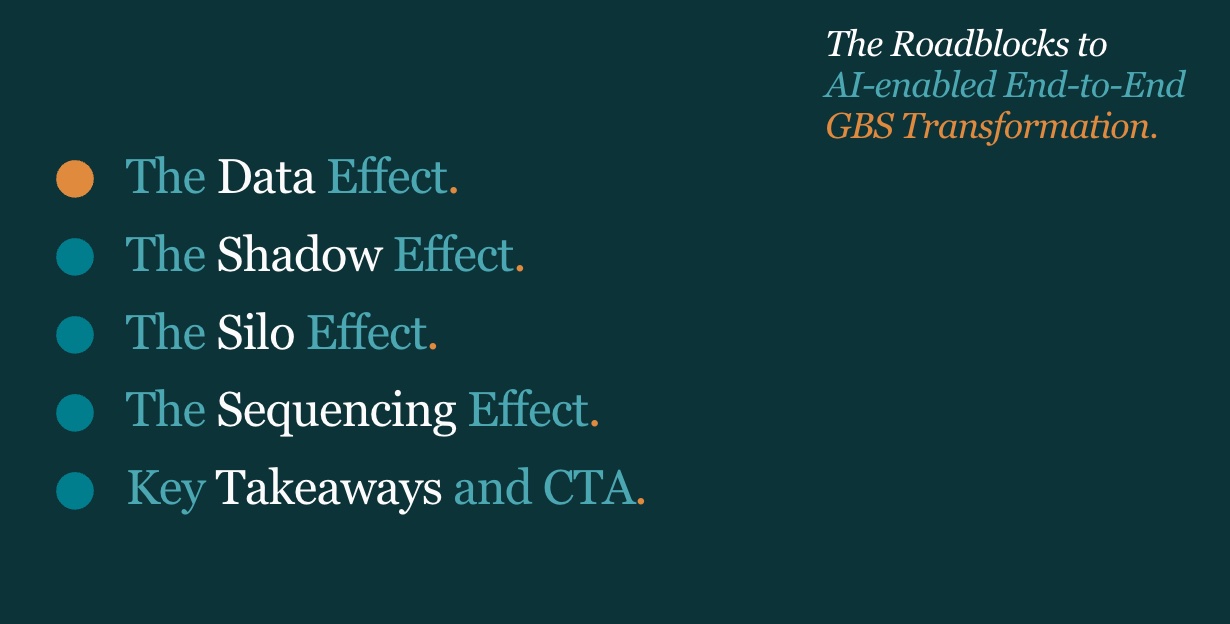
Over the past few weeks I've been building a keynote for SSOW Autumn in Amsterdam, on a theme SSON gave me: The Roadblocks to AI-enabled End-to-End GBS Transformation. This edition is the written version of that keynote: for everyone who couldn't be in the room, and for those who were and want to go deeper.
It became one of the most valuable reflection exercises of my year. The build forced me past the usual answers and into the real reasons AI keeps delivering lukewarm impact in GBS. That's despite what we all know: GBS will be one of the strongest playing fields for AI, with all the hopes and fears that brings.
The brief quoted a poll I ran with this community earlier in the year. 42% of you said Data isn't ready. 25% said proving ROI beyond pilots. 17% said scaling from POC, and another 17% said stakeholder trust. When I followed up in May asking what is actually broken, half of respondents pointed to the same root cause: lack of Data ownership.
So I took a step back and did my own connecting of the dots: between those numbers, a lot of reading across sources and thought leaders, and the frameworks we've built together in previous editions. What came out is a conviction. We are ignoring, or underplaying, four effects. Left unattended, each one becomes a real obstacle to success, to scalability and, inevitably, to ROI.
They may seem obvious. Hear me out, and let's explore them carefully together.
1. The Data Effect
Master Data is the Cipher Key. I've said it many times, in Edition #4 and on more stages than I can count, and it is the effect I have proven both personally and professionally.
Take one customer. In the CRM it's ABC Ltd. In the ERP it's ABC Limited. In Finance it's ABC Corp. Without the Cipher Key, AI doesn't just fail to understand the relationship. It invents one. It doesn't reject bad Data; it builds connections that look sophisticated and are fundamentally wrong.
So the first question is not "which AI use case next?" It's "where does my Data actually stand?" The Good, the Bad & the Ugly is the framework for action I keep returning to, because it forces an honest starting point:
- The Good: clean, governed, owned. Ready for AI.
- The Bad: usable, but reconciled by hand. Fine for reporting, risky for AI.
- The Ugly: siloed, contradictory, unowned. Dangerous for AI.
AI amplifies whatever you feed it. Feed it the Good and you build advantage. Feed it the Ugly and you scale the damage.
Master Data is also the hidden foundation. Skyscrapers don't fail because of what you see; they fail because of what you can't. The taller our AI ambitions, the deeper that foundation must go. Many of the AI skyscrapers being built today stand on sand.
The proof point I know best is Project V.A.U.L.T., a fraud-prevention capability. Before AI could add any value, around 475,000 scattered vendor and bank-account records were consolidated into 125,000 verified golden records: 73% obsolete Data eliminated. That clean-up was the key success factor. Now imagine what an AI model would have inferred from the 350,000 obsolete records left behind.
2. The Shadow Effect

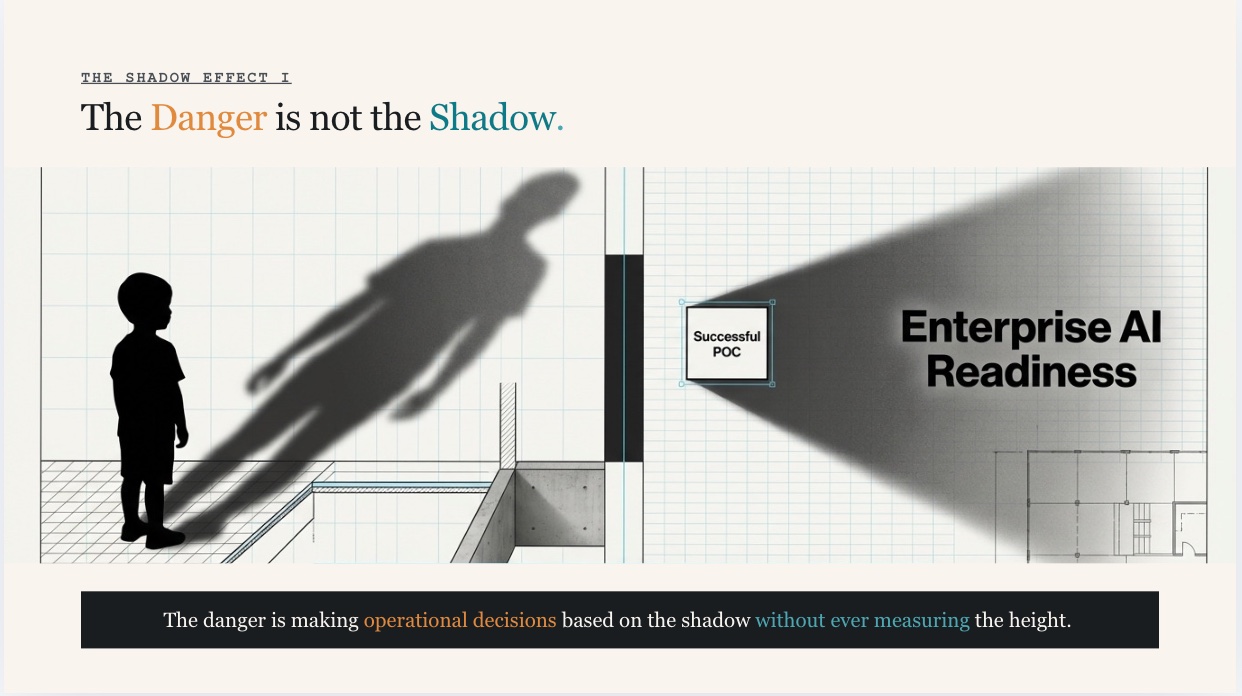
In Edition #10, I shared a moment with my daughter. Walking a step ahead of me, she looked down at our shadows on the pavement, saw they were the same length, and concluded she was as tall as me.
The shadow wasn't lying. It just wasn't measuring height.
The same thing happens in many AI programmes. A successful POC casts a long shadow, and we read it as enterprise AI readiness. Vendor demos, industry benchmarks and pilots on curated Data all lengthen the shadow. None of them measure the height.
The danger isn't the shadow. The danger is making operational decisions based on the shadow without ever measuring the height.
Which leaves us with an uncomfortable paradox: in the most data-rich era in human history, why are we choosing assumption over evidence?
It helps to name the stages clearly, in what I call the Lexicon of Truth:
- Perception: a belief based entirely on how things seem.
- Assumptions: the unverified foundations built on top of perception.
- Facts: evidence-backed truth, delivered without sugar-coating.
- Reality: what actually exists when you strip away the narrative.
Most AI business cases are written somewhere between the first two. Most failures are discovered in the last.
3. The Silo Effect
In Edition #2, I reframed Data silos as Data Hedges. Silos aren't designed to cause problems. Like hedges in a garden, they start as natural, intentional boundaries: Finance, Supply Chain and HR, each with its own systems. That's order, not dysfunction.

But hedges grow. I see it as a Boundary-to-Barrier Lifecycle in three phases:
- Intentional order: controlled perimeters, set up for good reasons.
- The creep: continuous, natural growth that nobody trims.
- The silo: line of sight disappears and Data is trapped.
Take procure-to-pay running across procurement, the ERP and finance. How long do requisitions wait? Where do approvals bottleneck? Why does invoice matching fail? Each system holds only a fragment of the answer, so the digital twin of the real Process never comes together.
You cannot diagnose Data or a Process across an ecosystem you cannot see. And neither can AI.
Silos aren't the problem. Untrimmed hedges are, and the trimming never ends.
4. The Sequencing Effect
The last effect is the one I see most often, and the most avoidable.
The Broken Sequence goes like this. A business need arrives, and the first move is a technology decision, usually on the back of AI promises. Fit-to-standard is pushed until it fits, breaks, or erodes the business case. Then we discover the Data isn't ready, there is no time to Get Clean, Stay Clean before go-live, and ownership is unclear. The Process comes last, assumed not to change, and upstream and downstream operations absorb the cost in manual work.
You cannot AI your way out of a Data problem.
The Right Sequence reverses the order, and we've tested it multiple times:
- Desired outcome: define the target solution for the business need.
- Data: smart, clean, governed. The Cipher Key everything reads from.
- Process: the Perfect Process from Edition #12, designed in parallel, outcome backwards.
- Tech: a small number of smart choices, not a platform crusade.
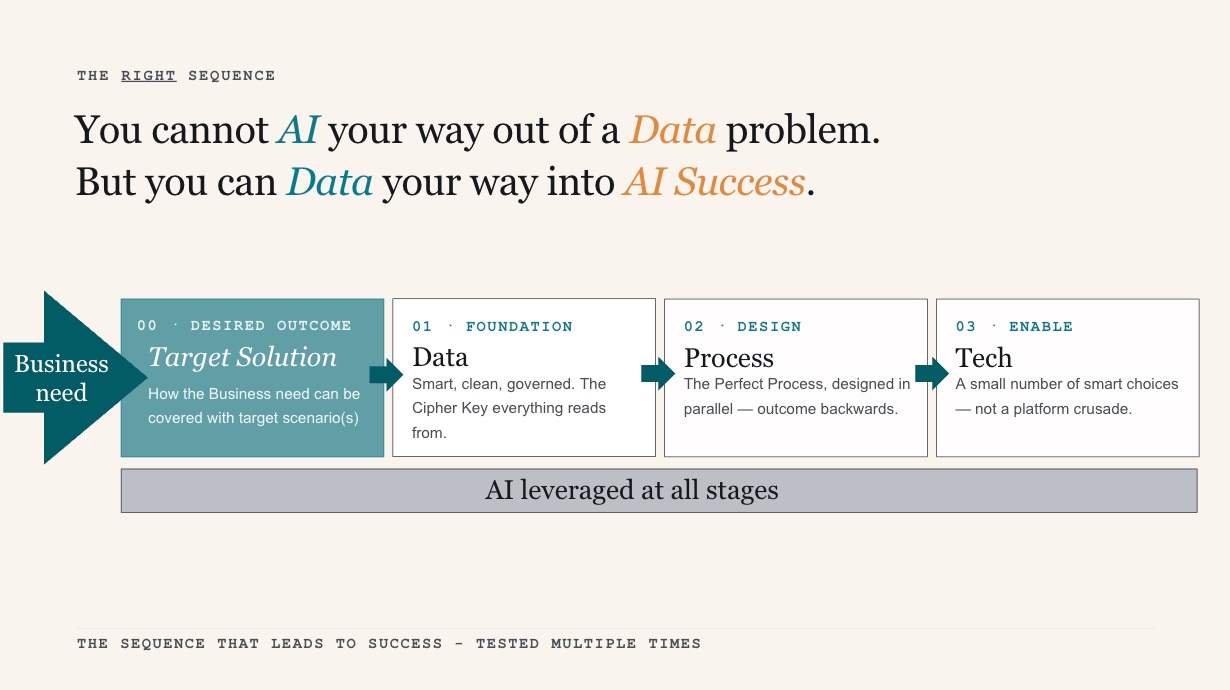
AI is leveraged at every stage, not bolted on at the end. That is the Acceleration Paradox: AI doesn't let you skip the sequence, it lets you run it faster.
One thing doesn't move: the orchestration layer is Human. Process Owners and Data Stewards stay accountable for the guardrails. They design, control, judge, supervise and govern the Data, the Process and the Business Context, using AI responsibly and ethically. Not humans out of the loop. Humans on top of the loop.
Connecting.The.Dots
Four effects, each feeding the next:
- Master Data is the Cipher Key. Without it, AI invents its own. Where does your Data stand: Good, Bad or Ugly?
- Facts above assumptions. Measure the height, not the shadow, before plunging into AI.
- Silos need constant trimming. You can't fix what you can't see. And neither can AI.
- Sequence beats speed. Desired outcome → Data → Process → Tech.
Pick one effect and act on it this month:
- Data Effect: assess where your Data stands and build concrete actions to get it to Good.
- Shadow Effect: map your reality with the same rigour you apply to your roadmap.
- Silo Effect: remove the obstacles blocking Data and Process visibility.
- Sequencing Effect: check whether your highest-investment AI use cases followed the Right Sequence.
You cannot AI your way out of a Data problem. But you can Data your way into AI success.
So here is my question for you: which of the four effects is quietly holding back your AI ambitions, and when did you last measure your height rather than your shadow?
New here? Start with these
If you've just subscribed, each effect has its roots in an earlier edition:
- Edition #2: The Missing Element, Making the Invisible Visible — Data Hedges, the origin of the Silo Effect.
- Edition #4: Cracking the Code, Data Readiness for AI — Master Data as the Cipher Key.
- Edition #10: The Shadow Effect, How Assumptions Are Shaping Our AI Reality — perception versus reality in AI adoption.
- Edition #12: Reengineering the Corporation for the AI Era — the White Canvas and the Perfect Process.
The content of this article is based on the author's own independent reflections and thoughts and is not in any way associated with any company or organisation and has no commercial intent.