To Standardise or to Harmonise, That Is the Question
Standardise the tuning, harmonise the music. Why a small, non-negotiable core of standards — and a large layer of harmonisation on top — is the model AI finally makes affordable.
Thanks to my wife, I have recently come to a deeper understanding of what it really means to harmonise. I'll come back to that in a moment. More importantly, I have also come to see that a concept I have been obsessed with for years, standardisation, needs to be put back in its place.
If you are reading this edition, welcome, and thank you for joining the conversation. If you are not yet familiar with Connecting the Dots, it is my personal newsletter: a place for independent thinking, for sharing perspectives, and for exploring what the future may look like at the intersection of Data, Process and Business. I love this intersection. It is where I have spent the best years of my career, and where I have learnt the most.
Let's unpack the title of this edition.
A Confession from a Standardisation Advocate
For years, I pushed for standardisation in many projects and initiatives. One template, one definition, one way of doing things, everywhere. That pathway remains essential for achieving scale and cost efficiency. But taken to its extreme, it becomes counterproductive in a world where staying flexible, agile and entrepreneurial is key.
So, as I continued my own transformation journey in the Data space, I started questioning myself. How much does Data really need to be standardised, given that standardisation still carries significant cost and effort? And where does that cost stop paying for itself?
That is when I began to look harder at another term we hear a lot in corporate jargon: to harmonise. It has always felt a little fluffier, as if everyone gets their say. In practice, we treat it as a transition step on the way to the real summit, the standardisation dream that is still the north star.
What the Words Actually Mean
Then my wife, who has a particular connection with the concept of harmony, shared her perspective. (Thank you, Dalia.) To harmonise is, quite simply, to bring into harmony, to make harmonious.
Wow. If that is what harmonising means, why isn't harmonisation our north star?
That sent me to the roots of both words, and what I found surprised me.
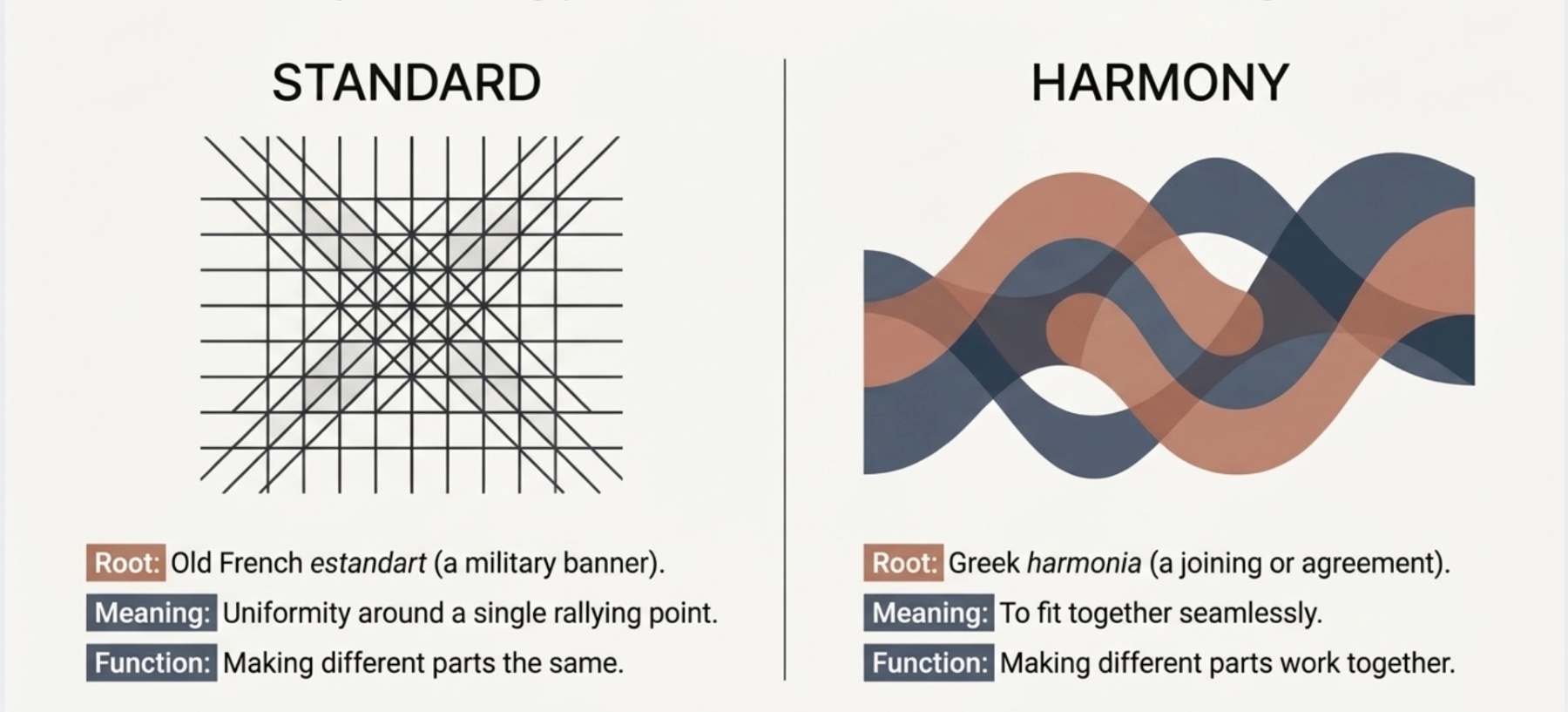
"Standard" comes from the Old French estandart, a military banner: the single flag everyone rallies to. Only later did it come to mean an authoritative measure. Standardisation, at its root, is about uniformity around one rallying point.
"Harmony" comes from the Greek harmonia, meaning a joining or agreement, from harmozein, to fit together. Harmonisation is not about making the parts the same. It is about making different parts fit together.
That distinction changes everything.
Standardise the Tuning, Harmonise the Music
Think of an orchestra. Violins, cellos, oboes, timpani. Completely different instruments, different sounds, different roles. Nobody would suggest that the orchestra would sound better if every musician played the violin.
But before a single note of the concert is played, something very precise happens. The whole orchestra tunes to the same reference pitch. That reference pitch is literally an international standard. The musicians then play in the same key and follow the same score.
So harmony does not reject standards. It depends on them, but on very few of them, applied exactly where they matter. Everything above that thin layer of standards is diversity, played in harmony.
This is where, as a Data practitioner, it finally clicked for me. Our job is not to make every instrument the same. Our job is to make sure every instrument is tuned and plays its part in the full melody.
In Data terms, the tuning is a small set of things that must be standard:
- Identifiers: so we know the same customer, supplier or product is the same entity everywhere.
- Reference Data: currencies, units of measure, countries, the shared vocabulary of the business.
- Definitions and semantics: a common understanding of what "customer", "vendor" or "net sales" actually mean.
Everything else can be harmonised: local attributes, market-specific product structures, regional Process variations, the personalisation consumers increasingly expect. Data quality, governance, business rules and Data dictionaries are what keep it all in tune.
Inverting the Weight
So this is not about throwing standards away. It is about inverting the weight.
The model many of us grew up with looked like this: standardise as much as possible, and harmonise whatever is left over, reluctantly, as an exception. A large base of standards, a small tolerance for difference.
I now believe it should be the other way round. A small, non-negotiable core of standards, and a large layer of harmonisation built on top of it.
Why? Because extreme standardisation is where cost and effort get out of control. Every additional attribute you force into a global template, every local variation you try to eliminate, costs more than the last, and returns less. Worse, it fights the business itself. Companies need diverse products. Consumer preferences count. Markets are different for good reasons. At some point, the pursuit of uniformity stops being an efficiency play and becomes a tax on agility.
Where AI Changes the Equation
So why does this matter now, and not ten years ago?
Because AI changes the economics of harmonisation. Reconciling different structures, mapping dialects of "customer" across systems, and translating local variations into a comparable picture used to be slow, manual and expensive. That is exactly why we defaulted to standardisation: it was cheaper to force everyone into one format than to keep translating between many. AI can now do much of that translation work at scale and at a fraction of the cost.
But let me be very clear, because regular readers will remember Edition #4. AI can only translate between dialects if there is something to translate against. Without the tuning, AI does not harmonise. It improvises. It invents its own cipher key, and that is where hallucination begins.
This is why Master Data as the Cipher Key still holds. If anything, it becomes more important. The cipher key gets smaller, but it becomes more critical. You cannot AI your way out of a Data problem. But with a well-tuned core, AI can play the rest of the orchestra in harmony.
It is also a reminder of something I wrote back in Part 2 of the Generative AI series, when I introduced the Virtuoso Dynamic Model as the harmonisation of Data quality, Process excellence and technology. I chose the word harmonisation then. I am only now understanding how deliberately I should have meant it.
Your Turn: This Edition Is a Conversation
This edition is not here to convince you. It is here to make you think, and to invite you to share your views.
In fact, this is my first "talk to the audience" edition. I want to hear your views and your perspectives. I want to bring more of you, the readers, into the newsletter, because your voice has become essential. Connecting the Dots was never meant to be a monologue or a megaphone.
So step up and give me your best arguments. To get us started:
- Where does your organisation genuinely need a single standard, the non-negotiable tuning, and how small could that core really be?
- Where has standardisation cost you more than it returned? Where did the pursuit of uniformity become a tax on agility?
- Can AI harmonise Data that has no shared dictionary, or is the tuning standard still a human responsibility?
The content of this article is based on the author's own independent reflections and thoughts and is not in any way associated with any company or organisation and has no commercial intent.